
Quick Answer
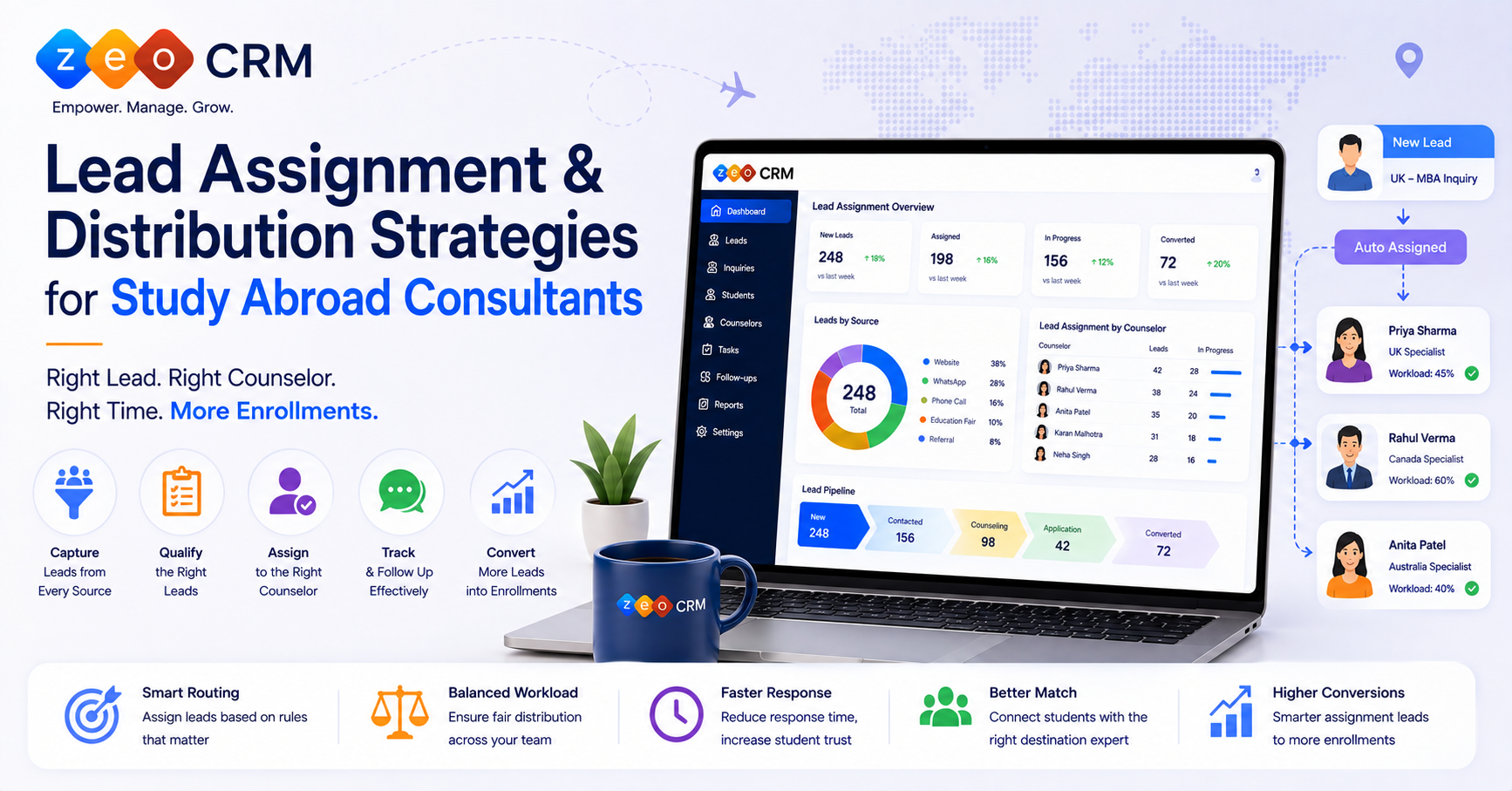
Lead assignment is the process of allocating a new lead to a specific counselor who becomes responsible for following up with that inquiry. For study abroad consultants, assignment can be based on destination, counselor specialization, workload, geography, lead source, lead score, or other predefined rules. The goal is not simply to distribute leads, it is to get the right lead to the right counselor at the right time.
Introduction
Study abroad consultancies get inquiries from everywhere: website forms, WhatsApp, phone calls, social media, paid advertising, education fairs, referrals, university partnerships and walk-ins. But generating a lead is only half the job. If that lead does not reach the right counselor quickly, the consultancy ends up dealing with delayed responses, uneven workloads, missed follow-ups, unclear ownership, and leads that quietly go cold.
At ZeoCRM we see this exact pattern play out with growing consultancies constantly. This guide walks through what lead assignment actually means, how it differs from distribution, and seven practical strategies for routing student leads to the right counselor every time.
What Is Lead Assignment?
Lead assignment is the process of allocating a newly captured lead to a specific counselor, salesperson or team member who becomes responsible for following up with that inquiry. It matters because a lead without a clear owner tends to sit untouched, and assigning ownership is what turns a raw inquiry into an active, accountable follow-up.
Assignment can happen manually, with someone deciding case by case, or through automated rules built into a CRM. Either way, the general flow looks like this:
Lead Generated → Lead Captured → Lead Qualified → Assignment Rule Applied → Counselor Assigned → Follow-Up
For a broader look at how this fits into the full CRM picture, see our complete guide to CRM for study abroad consultants.
What Is Lead Distribution?
Lead distribution and lead assignment often get used interchangeably, but the distinction is genuinely useful operationally. Distribution determines how leads get allocated across a team. Assignment determines who actually owns each individual lead once it lands. Picture 100 new student inquiries arriving in a week: distribution rules decide how those inquiries spread across the team, while assignment determines exactly which counselor becomes responsible for each one.
| Lead Distribution | Lead Assignment |
|---|---|
| Determines allocation | Determines ownership |
| Focuses on routing | Focuses on responsibility |
| Can spread leads across teams | Usually identifies a specific owner |
| Driven by allocation rules | Creates accountability |
Why Lead Assignment Matters for Study Abroad Consultants
Effective lead assignment helps study abroad consultancies route inquiries quickly, balance counselor workloads, establish ownership, and connect students with counselors who are appropriate for their destination, course or other requirements.
Faster lead response matters because the gap between an inquiry and a counselor actually picking it up is exactly where students start looking elsewhere, though a fast response alone does not guarantee a conversion. Better workload management prevents a situation where some counselors drown in leads while others sit underutilized, and fewer unattended leads happen naturally once ownership is clear. A better student experience follows when inquiries reach counselors who understand that student’s destination or course, and clear accountability means every lead has an identifiable owner and a defined next action, rather than sitting in a vague “someone will get to it” state.
The relationship worth remembering: right lead, right counselor, right time, consistent follow-up.
7 Lead Assignment Strategies
There is no universally best lead assignment strategy. The right approach depends on your consultancy’s size, counselor expertise, destinations served, lead volume, workload and organizational structure.
1. Round-Robin Assignment
Round robin lead distribution sends new leads sequentially to available counselors: Lead 1 to Counselor A, Lead 2 to Counselor B, Lead 3 to Counselor C, Lead 4 back to Counselor A, and so on.
This works best for small teams with relatively similar counselor skill levels who want equal allocation above all else. It is simple to implement, though it does not account for specialization, destination expertise, workload or lead quality. A consultancy receiving 30 general inquiries might distribute them evenly across five counselors this way, regardless of what each student actually needs.
2. Assignment by Counselor Specialization
Lead assignment by specialization routes leads based on counselor expertise, whether that is country knowledge, course type, visa experience, student segment or specific university familiarity. A UK postgraduate inquiry, for example, would route straight to your UK postgraduate specialist rather than whichever counselor happens to be free.
This works well for consultancies with clearly defined counselor expertise, since it connects students with genuinely relevant knowledge. The catch is that it requires accurate mapping of who specializes in what, and it can create uneven workloads if one specialty gets far more inquiries than another.
3. Assignment by Destination
Destination-based routing sends leads to counselors based on the student’s preferred study country: Australia inquiries go to your Australia counselor, UK inquiries to your UK counselor, and so on for Canada, USA and New Zealand.
This creates clear destination ownership and tends to simplify workflows for multi-country consultancies. The limitation is that one destination might generate substantially more inquiries than another, creating a real workload imbalance if you are not watching for it.
4. Assignment by Workload
Workload based lead assignment, sometimes called capacity based lead assignment, factors in each counselor’s current active workload before routing a new lead.
| Counselor | Active Leads |
|---|---|
| Counselor A | 15 |
| Counselor B | 7 |
| Counselor C | 4 |
A new inquiry here would likely go toward Counselor C, provided they are otherwise a suitable match. This prevents counselor overload, though workload alone does not account for expertise, so capacity should complement expertise rather than replace it.
5. Assignment by Geography
Geographic lead routing sends inquiries to counselors based on city, state, region, office or time zone. A Chandigarh region inquiry, for instance, would route to your Chandigarh counseling team. This suits multi-office consultancies well, though it is less useful for a centralized team serving students nationally.
6. Assignment by Lead Source
Lead assignment by source routes inquiries based on where they originated: website, referral, paid campaign, social media, education fair, university partnership or walk-in. A lead coming through a university partnership might route specifically to your partnership counseling team.
This creates clearer ownership for specialized acquisition channels, though having too many source-specific teams can create unnecessary silos if you are not careful.
7. Assignment by Lead Score
Lead scoring and assignment uses a defined score, built from criteria like academic eligibility, destination preference, course interest, intake, budget, engagement and readiness to apply, to influence where a lead goes. A high intent lead might route straight to an experienced counselor, while a lower intent lead goes into a general nurturing workflow instead.
This helps align counselor effort with actual lead priority, but it requires a reliable scoring model that gets reviewed regularly, or the routing starts making bad calls.
Which Lead Assignment Strategy Is Best?
The best lead assignment strategy depends on what your consultancy is actually trying to optimize. Round-robin works when equal distribution is the priority, while destination, specialization, workload, source, geography or lead score routing may fit better when the characteristics of your leads actually matter.
| Strategy | Best For | Main Limitation |
|---|---|---|
| Round Robin | Equal distribution | Ignores expertise |
| Specialization | Expert teams | Requires expertise mapping |
| Destination | Multi-country teams | Potential imbalance |
| Workload | High volume teams | Needs accurate workload data |
| Geography | Multi-office teams | Limited use for centralized teams |
| Lead Source | Channel based teams | Potential silos |
| Lead Score | Different lead priorities | Requires reliable scoring |
Mature consultancies often combine multiple rules rather than picking just one, for example destination first, then specialization, then workload, then lead score. The right hierarchy depends entirely on your own consultancy’s structure.
How to Build an Effective Lead Assignment Process
Start by defining your assignment criteria, deciding which factors actually matter for your team, then map counselor expertise by documenting country, course, visa and other relevant knowledge. Define counselor capacity so workload has an actual measurement behind it, then turn your criteria into clear assignment rules and establish ownership rules for who is responsible once a lead is assigned. From there, monitor assignment performance over time and review and optimize the rules as lead volumes, destinations or priorities shift.
The mini framework worth remembering: criteria, rules, assignment, ownership, monitoring, optimization.
Manual vs Automated Lead Assignment
Manual assignment can work fine for smaller teams with lower lead volumes, while automated assignment becomes more useful once a consultancy receives larger or more complex volumes of inquiries.
| Factor | Manual Assignment | Automated Assignment |
|---|---|---|
| Speed | Depends on staff availability | Rule dependent |
| Consistency | Can vary | More consistent |
| Scalability | Limited | Higher potential |
| Rule based routing | Limited | Stronger |
| Reporting | May require manual work | Easier when integrated with CRM |
It is worth being clear here: automation executes a well-designed assignment rule. It does not replace the need for a sound routing strategy in the first place.
How CRM Software Automates Lead Assignment
CRM lead assignment allows incoming inquiries to be captured, evaluated against predefined rules, assigned to an appropriate counselor, and tracked through subsequent follow-up.
Lead Captured → Assignment Rules → Counselor Assigned → Notification → Follow-Up → Tracking → Reporting
A CRM built for this typically offers centralized lead capture, clear lead ownership, configurable assignment rules, counselor notifications, follow-up tracking, lead source tracking and performance reporting, with workflow automation layered on top where supported.
Common Lead Assignment Mistakes to Avoid
Relying only on round-robin for every lead, ignoring counselor specialization, overloading your most experienced counselors, and not defining clear ownership are some of the most common issues. Others include delaying assignment, having no reassignment process when a counselor is unavailable, not tracking lead aging, ignoring how different sources actually perform, and never reviewing routing rules once they are set.
A lead assignment process becomes ineffective when ownership exists on paper but there is no clear rule for response time, reassignment, follow-up or escalation.
How to Measure Lead Assignment Performance
Metrics should help improve your routing rules, not simply rank counselors against each other. Worth tracking: lead assignment time, lead response time, active leads per counselor, unassigned lead count, lead aging, follow-up completion, and downstream counseling, application and enrollment conversion.
Assignment Time → Response Time → Follow-Up → Counseling → Application → Enrollment
Downstream conversion metrics provide useful context, but they should not be treated as proof that one routing strategy alone caused a particular outcome.
How ZeoCRM Helps Automate Lead Assignment
Study abroad consultancies often need more than a place to store student inquiries. They need a structured way to capture leads, establish ownership, manage follow-ups and monitor the recruitment pipeline as it grows.
| Consultancy Problem | CRM Capability | Operational Benefit |
|---|---|---|
| Unassigned inquiries | Centralized lead management | Clear ownership |
| Manual routing | Lead assignment workflows | Less manual intervention |
| Uneven workload visibility | Lead and pipeline visibility | Better workload management |
| Missed follow-ups | Follow-up management | More consistent engagement |
| Limited source visibility | Lead source tracking | Better understanding of channels |
ZeoCRM brings centralized lead management, clear lead ownership, a visible student recruitment pipeline, follow-up management, lead source tracking and counselor performance reporting into one place. If your consultancy is managing growing student inquiry volumes, ZeoCRM can help you bring lead management, counselor ownership, follow-ups and recruitment workflows into one system. Talk to an expert to see how it fits your team.
Key Takeaways
Lead assignment determines who owns a lead, while lead distribution determines how leads get allocated in the first place. Round-robin works for simple equal distribution, specialization and destination routing align students with relevant expertise, and workload based routing helps manage counselor capacity. Geography and lead source support specific organizational structures, and lead scoring helps prioritize higher intent inquiries. CRM automation reduces manual routing work, but assignment rules still need to be monitored and refined over time.
The goal is not simply to distribute every inquiry. It is to build a routing process that consistently connects each student with the most appropriate counselor while keeping ownership clear and workloads manageable.
Frequently Asked Questions
What is lead assignment? It is the process of allocating a new lead to a specific counselor who becomes responsible for following up with that inquiry.
What is the difference between lead assignment and lead distribution? Distribution determines how leads get allocated across a team, while assignment determines who specifically owns each individual lead.
What is round-robin lead assignment? It is a method that sends new leads sequentially to available counselors in rotation, regardless of expertise or workload.
Can CRM software automate lead assignment? Yes, most modern CRMs let you set predefined rules that automatically route leads to the right counselor based on your chosen criteria.
What is the best lead assignment strategy for an education consultancy? There is no single best strategy. The right choice, or combination of strategies, depends on your consultancy’s size, counselor expertise and lead volume.
How does lead scoring affect lead assignment? It lets consultancies route higher intent leads to more experienced counselors while sending lower intent leads into a nurturing workflow instead.