
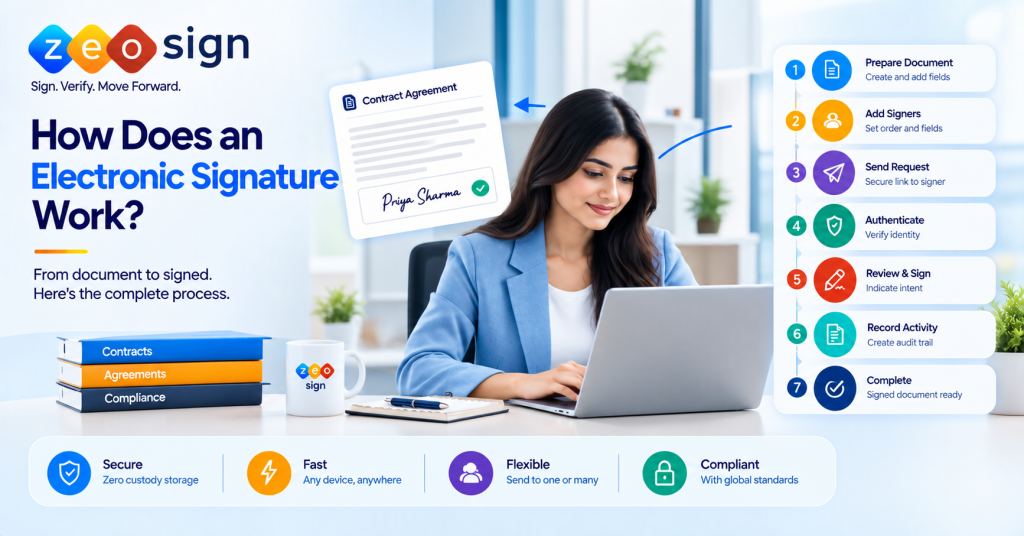
An electronic signature workflow typically involves preparing a document, identifying or authenticating the signer, capturing their intent to sign, applying the signature, recording relevant signing activity, and completing the document. This lines up with how electronic signatures are commonly defined in law and policy, as a method that identifies and authenticates a person as the source of a record and indicates their approval of it.
Quick Answer
When you electronically sign a document, a few things happen behind the scenes. A document is prepared for signing, you receive access to it, you may be authenticated depending on the workflow, you review the document and indicate your intent to sign, the signature is applied, relevant signing activity is recorded, and the completed document along with associated evidence is made available. The exact process varies by platform, authentication method, document type and jurisdiction.
How Does an Electronic Signature Work?
At a high level, an electronic signature moves through a fairly predictable sequence: document, signer, authentication, review and consent, signature, audit trail, completion. Each stage plays a specific role in making sure the final signed record actually means something.
| Stage | What Happens | Purpose |
|---|---|---|
| Document preparation | Document is prepared for signing | Establish the document being signed |
| Signer access | Signer receives a signing request | Give the intended signer access |
| Authentication | Identity or access may be verified | Help establish signer identity |
| Review and consent | Signer reviews and indicates intent | Establish intent to sign |
| Signature | Signature is applied | Record the signing action |
| Audit trail | Relevant events are recorded | Preserve evidence of the transaction |
| Completion | Workflow is finalized | Produce the completed signing record |
The Electronic Signature Process Step by Step
This is where the actual mechanics come in, from the moment a document is created to the moment it is fully signed.
1. Document Preparation
Before anything is sent for signing, the document itself needs to be ready. This means finalizing the content, uploading or selecting the file, and preparing the fields that will need to be filled in, such as signature blocks, date fields or initials. At this stage, the sender also decides whether there will be one signer or several.
2. Add Signers and Signing Fields
Next, the sender identifies who needs to sign and assigns responsibilities accordingly. Signature fields, date fields and any other required fields get placed on the document. If there is more than one signer, this is also where a signing order can be set, so that one person completes their part before the next person gets access.
3. Send the Signature Request
Once the document is ready, a signature request goes out. This usually triggers a notification to the signer along with secure access to the document and instructions on what needs to be done. It is worth noting that the signature request itself is not the same thing as the actual signature event. The request just opens the door.
4. Authenticate the Signer
Authentication varies quite a bit depending on the platform and the level of assurance needed. Common mechanisms include email verification, one-time passwords (OTP), access codes, and in some cases fuller identity verification. It is important to keep in mind that authentication helps establish who is accessing or signing the document. It is not the electronic signature itself.
India’s CCA eSign framework is a useful example here. It allows signer authentication through e-KYC combined with OTP or biometric verification, alongside consent and audit trail mechanisms built into the process.
5. Review the Document and Indicate Intent to Sign
The signer opens the document, reviews its contents, fills in any required fields, and reaches the point where they need to sign. Indicating intent to sign, whether by clicking a button, drawing a signature or applying a typed one, is a meaningful step in the process rather than just a formality. The signature itself is part of a broader signing event, not simply an image dropped onto a page.
6. The Electronic Signature Is Applied
Once intent has been established, the signature is associated with the electronic record and the platform logs the signing action. The exact technical mechanism behind this varies between signature types and platforms. Not every electronic signature relies on a cryptographic digital signature certificate. Some do, some don’t, and this distinction matters more than people often realize.
7. Signing Activity Is Recorded
Throughout the process, relevant details get recorded, including who signed, when they signed, what authentication took place, and the document’s status at each point. This forms an audit trail, which is essentially a chronological record of events tied to the signing process. What exactly gets recorded depends on the specific platform.
8. The Document Is Completed
Once all required signatures are in place, the workflow is finalized. This produces a final document along with its associated audit information, which can then be accessed, downloaded or stored depending on how the platform is set up.
What Happens Behind the Scenes When You Sign Electronically?
There is more going on underneath a simple click than most people realize. A few concepts worth understanding:
Authentication establishes or verifies access to the person signing.
Intent and consent provide evidence that the signer actually meant to approve the document, not just accidentally clicked through it.
Signature association connects the signing event to the specific electronic record in question.
Timestamping records when an event occurred, where the workflow supports it.
Audit trail captures relevant events across the whole transaction.
Document integrity refers to whether the document can be shown to have changed after signing, where the underlying signature technology supports that kind of check.
India’s IT Act specifically addresses requirements around linking or controlling signature creation and authentication data, as well as the ability to detect alterations to an electronic signature and the information it authenticates.
The general flow looks like this: signer access, authentication, consent, signature applied, activity recorded, verification or integrity check, and completion.
How Is an Electronic Signature Verified?
Verification is often confused with authentication, but they answer different questions. Authentication asks who is accessing or signing. Verification asks whether the signature is actually tied to the correct electronic record and whether that record has remained intact.
Email Verification
This is a basic form of access verification, confirming that the signer received and opened the request through a specific email address.
OTP Authentication
A one-time password sent to a phone or email adds another layer of confirmation before signing proceeds.
Access Codes
Some workflows require a code to access the signing request in the first place, adding a layer of control over who can even open the document.
Identity Verification
Higher-assurance workflows may go a step further and require additional identity checks before allowing someone to sign.
Cryptographic Verification
This is a more technical form of verification and worth keeping distinct from ordinary electronic-signature workflows. India’s CCA explains that digital signatures can be independently verified using software, and that they bind the electronic authentication to the specific document or transaction. This level of verification generally applies to digital signatures rather than every electronic signature.
ZeoSign supports authentication options such as OTP and access codes, along with a Video Sign feature. These are specific ZeoSign capabilities rather than universal requirements across all electronic-signature platforms.
What Happens After an Electronic Signature Is Added?
Signing isn’t really the end of the story. A few things typically follow:
- The signature event gets recorded.
- The document’s status updates accordingly.
- Audit or activity information may be updated in real time.
- If there are additional signers, they complete their own steps.
- Once every required signature is in place, the document can be finalized.
- The completed document, along with its signing evidence, becomes accessible according to the platform’s own workflow.
| Post-Signing Element | Purpose |
|---|---|
| Signature status | Shows whether signing is complete |
| Timestamp | Records relevant event timing |
| Activity record | Shows workflow events |
| Audit trail | Preserves signing history |
| Document integrity evidence | Helps identify subsequent changes where supported |
| Completion record | Indicates completion of the workflow |
Not every platform generates a separate formal “completion certificate,” so it is worth checking what your specific provider actually delivers.
Are Electronic Signatures Secure?
It would be misleading to simply say electronic signatures are completely secure, because security really comes down to the platform, its authentication controls, access controls, document protections, audit records and how it’s all implemented.
It helps to think of it as layered protection rather than one single feature:
| Security Layer | What It Does |
|---|---|
| Authentication | Helps establish signer or access identity |
| Encryption | Protects data during applicable stages |
| Access controls | Limits who can access documents or workflows |
| Audit trail | Records relevant activity |
| Document integrity | Helps detect changes where supported |
| Tamper detection | Can identify alterations in supported implementations |
ZeoSign brings several of these layers together through security and encryption measures, authentication options, activity tracking, and its Zero Custody Storage model. That said, no platform, including ZeoSign, should be described as one hundred percent secure or fully tamper-proof, since security depends on how each layer is implemented and used.
How Does Electronic Signature Software Work?
Electronic signature software essentially coordinates everything discussed so far. It typically handles document preparation, assigning signers, placing signature fields, sending requests, managing authentication, capturing the signature, tracking status, recording activity, and finalizing the document. Many platforms also offer templates for repeatable workflows.
Not every platform offers identical features or the same security controls, so it’s worth comparing what matters most for your specific use case.
ZeoSign, for instance, brings together core e-signing, support for multiple signers, real-time tracking, reusable templates and Bulk Send for sending documents at scale. These features work together to move a document through the entire signing lifecycle without much manual coordination.
How Does Electronic Signing Work With Multiple Signers?
Not every document only needs one signature. Here’s how multi-party signing generally works:
Single signer means one person completes the entire workflow on their own.
Multiple signers means several people need to sign the same document before it’s considered complete.
Sequential signing means signer one completes their part before signer two even gets access to the document.
Parallel signing means multiple signers may receive access at the same time, without a strict order, depending on how the workflow is set up.
In-order signing is a more structured version of sequential signing, and it’s a specific ZeoSign feature that lets senders control the exact order signers complete their steps.
ZeoSign supports sending documents to one or multiple signers, In-order Signing for sequential workflows, and real-time tracking so senders can see exactly where things stand. Not every platform supports every routing model, so it’s worth checking which options are available before setting up a multi-signer document.
Example of an Electronic Signature Workflow
Here’s how this might look in practice, using a business agreement between a consultant and a client:
The consultant prepares the agreement, then adds two signers to the document. Signature fields are assigned to each person, and the signing request goes out. Each signer authenticates according to the workflow in place, then reviews the document. The first signer indicates their intent and signs, and once that’s done, the second signer completes their step. Signing activity is recorded throughout, and once both signatures are in place, the document is marked complete.
This example is meant to show how the mechanics work in sequence. It doesn’t automatically mean the resulting document is legally binding, since that depends on separate legal and jurisdictional factors.
Is an Electronic Signature the Same as a Digital Signature?
Not quite, and this is a common point of confusion. “Electronic signature” is a broad umbrella term that covers many different signing methods. “Digital signature” usually refers more specifically to a cryptographic signature mechanism. A digital signature can absolutely be considered a type of electronic signature, but the two terms shouldn’t be treated as automatically interchangeable.
In India, the CCA’s own material draws a clear line between electronic signatures, digital signatures, certificates, authentication and verification within the country’s legal and technical framework.
For a deeper comparison, see our guide on [electronic signature vs digital signature].
Are Electronic Signatures Legally Valid?
Legal recognition depends on several things: the jurisdiction you’re in, the type of transaction or document, applicable law, the specific signature method used, how authentication was handled, whether proper consent was captured, and recordkeeping requirements.
In India, the Information Technology Act provides legal recognition for electronic signatures in circumstances specified by law, and the broader statutory framework also addresses reliability and the ability to detect alterations after the fact. The CCA maintains the country’s framework covering electronic signatures, Certifying Authorities, eSign and related standards.
It would be inaccurate to say that all electronic signatures are automatically legally binding in every situation. Whether a specific signature holds up depends on the details.
For more on this, see [are electronic signatures legally binding].
How ZeoSign Simplifies Electronic Signing
ZeoSign brings the pieces of this process together in one place, rather than leaving you to coordinate document prep, authentication and tracking separately.
| ZeoSign Capability | Where It Fits |
|---|---|
| Core e-Signing | Applying electronic signatures |
| OTP/access-code authentication | Signer authentication |
| Video Sign | Video-based signing workflow |
| Multiple signers | Multi-party documents |
| In-order Signing | Sequential workflows |
| Bulk Send | Sending documents at scale |
| Real-time tracking | Monitoring signing status |
| Activity tracking | Reviewing signing activity |
| Reusable templates | Repeatable workflows |
| Security and encryption | Security layer |
| Zero Custody Storage | Document storage model |
One thing worth calling out specifically: with ZeoSign’s Zero Custody Storage model, documents stay in your own connected drive rather than being stored on ZeoSign’s servers. This is a specific design choice for ZeoSign, not something you should assume applies to every e-signature platform.
Looking to simplify document signing while keeping signing activity organized and trackable? Explore how ZeoSign can fit into your document workflow.
Frequently Asked Questions About How Electronic Signatures Work
How does an electronic signature work?
A document is prepared, the signer is given access and possibly authenticated, they review the document and indicate intent to sign, the signature is applied, relevant activity is recorded, and the document is completed.
How do electronic signatures work?
They follow a workflow of preparation, authentication, consent, signing and completion, though the exact steps can vary by platform and document type.
What is the electronic signature process?
It generally includes preparing the document, adding signers and fields, sending the request, authenticating the signer, reviewing and signing, recording activity, and finalizing the document.
How is an electronic signature verified?
Verification checks whether the signature is tied to the correct electronic record and whether that record has stayed intact, which is different from authentication, which confirms who is signing.
How are electronic signatures authenticated?
Common methods include email verification, OTP, access codes and, in some workflows, additional identity verification, depending on the level of assurance required.
What happens after an electronic signature is added?
The signature event is recorded, the document status updates, any remaining signers complete their steps, and once everything is done, the finished document and its audit trail become available.
Are electronic signatures secure?
Security depends on the platform’s authentication, encryption, access controls, audit trail and document integrity measures working together, rather than any single feature.
Can multiple people electronically sign the same document?
Yes, through either sequential signing, where each person signs in a set order, or parallel signing, where multiple people can access and sign without a strict sequence.
What information is recorded in an electronic signature audit trail?
Typically the signer’s identity, timing, the signing event itself, any authentication steps, and the document’s status throughout the process, though specifics vary by platform.
Is an electronic signature the same as a digital signature?
Not exactly. Electronic signature is the broader term, while digital signature usually refers to a specific cryptographic method that can be one type of electronic signature.
Are electronic signatures legally valid?
It depends on the jurisdiction, the transaction type, the signature method used and how authentication and consent were handled, so validity isn’t automatic in every case.
How does electronic signature software work?
It coordinates the entire process, from preparing documents and assigning signers to authentication, signing, tracking and finalizing the completed record.
Content reviewed: September 2026